Learning to Fly

March 10, 2012
- It's all good
November 14, 2010 - Instrument Checkride passed!
February 15, 2010 - Jen's first solo!
October 25, 2009 - Broadening my horizons
October 4, 2009 - And then there were two...
September 15, 2009 - On instruments...
March 28, 2009 - Leave the plane behind...
March 21, 2009 - Finally! A new
Private Pilot
March 20, 2009 - The anticipation is killing me
November 3, 2008 - The Cross-Country
Flights
July 17, 2008 - First Solo!
June 17, 2008 - Making progress
May 14, 2008 - First 3 lessons
April 25, 2008 - Getting Started
March 10, 2012 - It's all good
Sorry it's been a while since this has been updated, but there's
been a lot of activity in the household. So where does this
fine spring day have your intrepid flight students? What've
we been up to in the last year?
Out flying with some friends:


Watching the regatta:

Flying over the state capitol:

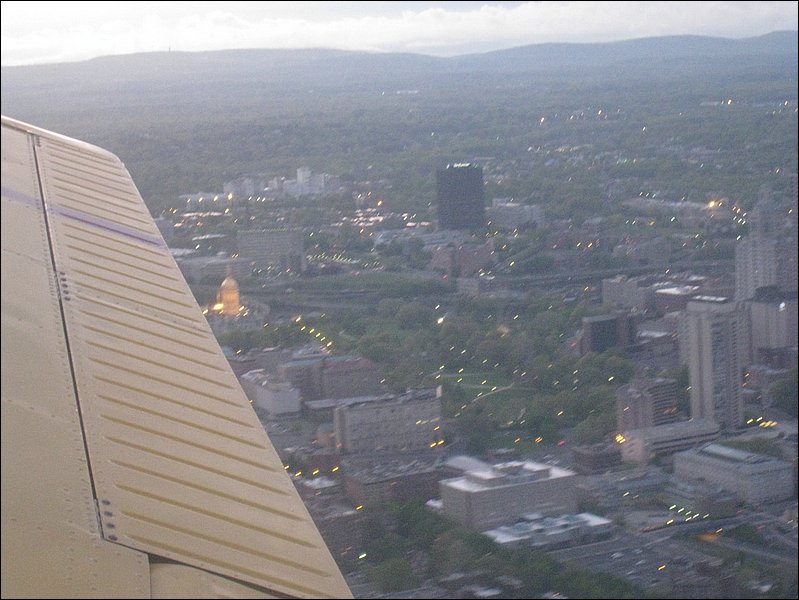
Getting above the weather:


Getting checked out in some complex and high-performance
aircraft:


Going to The City:

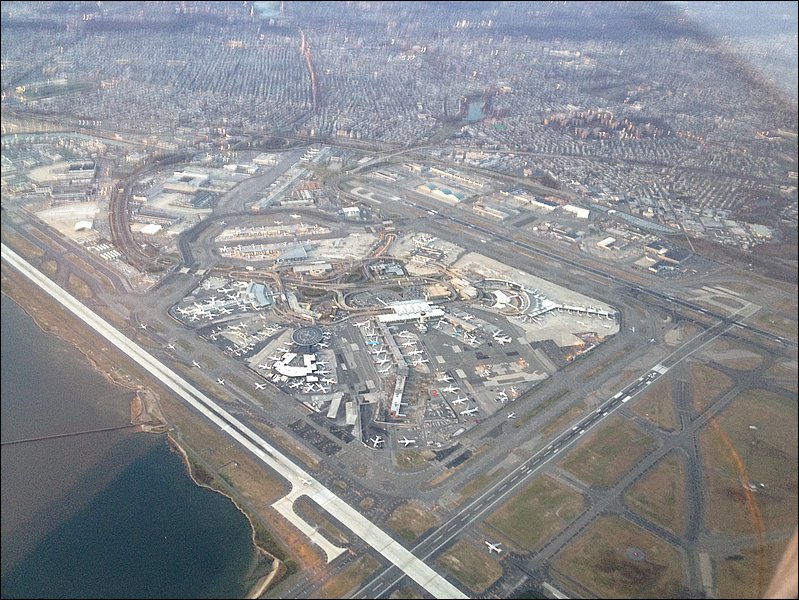
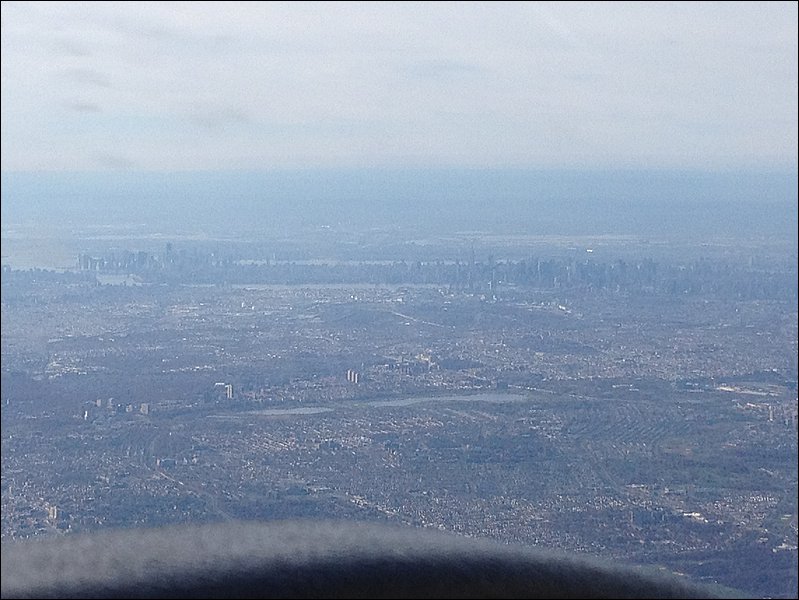
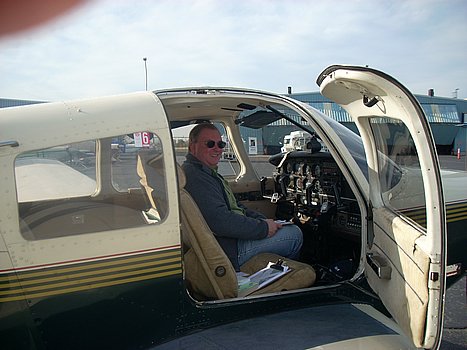
And when all is done, making sure everything looks good and safe
inside:

Since 2010:
- Jen got her Private Pilot and is making headway on the
Instrument rating, and is looking forward to some aerobatic time
in an Extra 300. She's also gotten her complex and high
performance endorsements, and logged some multi-engine turbine
time.
- I'm finishing up the hours needed for the Commercial license
(250 minimum), and looking forward to getting my CFI rating soon
after. I've also gotten my Ground Instructor license
(Advanced and Instrument) and am doing some teaching.
Some notes on the above photos:
- Formation flying is fun, just pay attention. The red
Cherokee Six at the top (600DK) was destroyed in an accident at
BDR last year (someone else was flying). That plane's been
replaced in the flying club by a twin-engine Piper Seneca III,
which we hope to start flying soon.
- IFR flying is fun, but it does take effort for the casual pilot
to stay current.
- Flying over JFK was really fun and the controllers made it very
easy and comfortable. Great view!
November 14, 2010 - Instrument Checkride
passed, and Jen's almost done too!
Today was another huge day - I passed the checkride for the
"Instrument-Airplane" rating. Now I'm legal to go fly in the
clouds, and in the airspace above 18,000'. It was another
long, tiring day, but I felt really proud when the examiner said,
"You did good." And it was a great flying weekend overall,
because Jen aced her private pilot written, so her checkride can't
be far away. Here's the story of my checkride day:
Preflight
If you read the story of my Private checkride,
you'll see it took me some effort to get to Danbury. This
time, since I was going to the same place, to meet the same
examiner, I decided to get up earlier and plan more time to get
there so I wouldn't be late. Glad I did, because as I was
getting all the paperwork ready, I went into the plane to find the
Airworthiness Certificate and Registration, but I couldn't find them
anywhere. Every plane is different, but in this Piper Archer,
there were no places in the cockpit, rear seats, or cargo area that
held a plastic holder for such important documents. I asked
the line crew guys, and they had no idea, but they gave me the
number for the chief mechanic. After banging my head a few
more times we figured out that in the rear seating area, if you sit
back there and lean over and to the left, you'll find them in a
plastic holder that's not visible because of the location and
angle. <Whew!> At least now I had all the logbooks and
paperwork to be legal to demonstrate airworthiness. I
double-checked the weather forecast again, not because we had any
chance of bad weather (it was a beautiful 60 degree day in
November!) but to show I had my flight plan current.
Getting
to Danbury (DXR)
All in all, I still took off 20 minutes later than I had hoped to,
but I got to DXR 5 minutes early, and didn't even have to go
around. I used the Bendix/King KLN90B GPS in the plane to make
it easier to locate the airport. When I went in to Executive
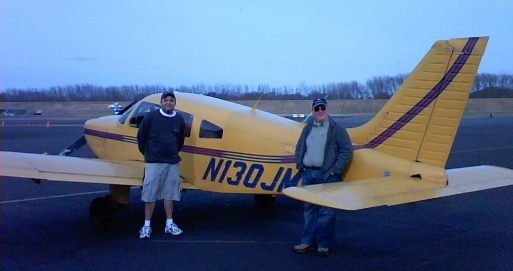
Air, Chauncey was looking out at the yellow
plane, and said he'd done checkrides in that plane many
times. That's promising. We took care of our IACRA
duties, poured a few cups of the same black coffee as last time, and
settled in for the oral exam.
The
Oral Exam
He used the ASA
Oral exam guide to choose some questions to help guide our
conversation. We went over important topics, like what you
have to do to stay legal and current, what instruments you really
need to be legal for a flight (you don't need an outside air
temperature gauge!), what system checks have to be done at what
intervals, which instruments are pitot-static and which are
gyroscopic, some failure scenarios, icing, departure procedure
types, VFR-on-top, cruise clearance, communication failure, what a
VFR GPS can be used for in IFR flight, the particular details of
91.175 regarding descent below the MDA, circle to land and the
protected area for circling. All in all, a good review of the
IFR system, and I must've done okay because after an hour we went
over the flight I had planned from DXR to PVD, discussed the
approaches we would do, told me to file the cross-country, and he'd
meet me out at the plane.
The
Flight Test
I preflighted the plane, and when he got in I offered to explain how
the seatbelts work and what we would do in an emergency landing, but
he assured me he knew how they worked. I called clearance
delivery for our clearance, but since they didn't answer (and hadn't
last time I tried to fly IFR out of DXR) I called on ground and they
gave us the clearance we expected: cleared to PVD via CMK V3 HFD
V167 PVD Direct, 3000' expect 7000' 5 after departure, departure
frequency on 126.4 and our squawk code. I then setup all the
frequencies, radials and other things needed for the departure so
that I wouldn't forget about them later. Then we taxied to
runway 17, checking to make sure the instruments turned as they
should, and after runup called for takeoff. We had to wait a couple
of minutes for them to activate our clearance, and then we tookoff
through the valley that surrounds the departure end of 17.
Got up to about 1200' and I put my foggles on, and with a slight bit
of prompting, turned direct CMK. Tower failed to contact us to
change to Departure and I told the examiner I'd ask for the change,
he said to wait until we got to about 3000' and if they hadn't told
us by then then we'd ask. They didn't, so I did, and when I
changed over found Departure asking if we were on the air. We
were, and they gave us a vector away from CMK and toward our airway,
and told to climb to 7000'. I continued the climb and set up
for our next likely frequency change, to Bradley Approach, and the
examiner took my low-altitude IFR chart and pointed to it and said
when we get to SORRY intersection, if they haven't had us change
over to Bradley, tell them we want vectors to the ILS at Bridgeport
(BDR). Just then they contacted us to change frequency (to the
one I predicted), and I called them back and said we had a change of
plans and would like to cancel IFR and get vectors to the BDR ILS 6
approach. They asked if everything was all right, and I said it was
fine, just had a change of plans. They acknowledged cancel of
IFR and gave us a southerly vector to place us outside the final
approach course on the BDR ILS 6.
Here's the area on the low-altitude chart, courtesy of
SkyVector.
Here's our route as seen on Flightaware:
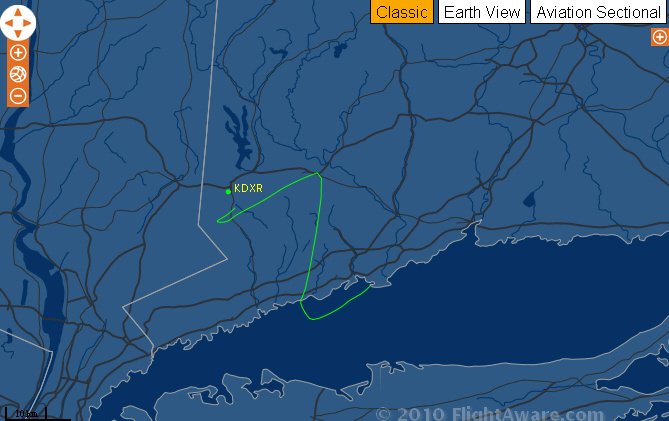
They vectored us out about 3 miles before STANE, the final approach
fix for the ILS 06 approach (the approach plate can be found here). I
intercepted the localizer and glideslope just like I'd practiced,
and tracked it down. Because the wind was favoring runway 11,
instead of 06, the tower asked if we could circle to 11 to
accommodate the other traffic in the pattern. Since a circling
approach is a requirement for the checkride we decided to get it
done here so just before reaching the shore, the examiner told me to
take off the foggles and go visual, and I found myself just left of
runway 06, and I broke off to the left at just over 400' and made a
quick turn, staying within 1.3 miles of the runway as required, and
placed it neatly on runway 11. As I did, I heard in my headset
the voice of my CFI, who was flying in the pattern with Jen at the
same time. It was nice hearing friendly voices.
We taxied back to 11 to takeoff again, and we headed northwest
direct to CMK. Along the way we took care of the other flight
maneuvers like steep turns and unusual attitudes, which were really
no different than for the private exam.
So off we went to CMK, to do the full VOR-A approach at DXR (plate here), including the
outbound procedure turn, where as you are about to cross the VOR,
you make a left turn to intercept radial 231 outbound, follow that
for a couple minutes to get far enough away to be able to turn
around and get lined up on your inbound heading. 2 minutes
outbound, then a 45° left turn to 186° for 1 minute, then a
180° right turn to 006°, all the time staying within 10
miles. My DME showed I was 4.5 away on my inbound turn which
was just fine. How do you get to your heading if you're
partial panel? By timing your turn. You get established on a
magnetic heading using your compass in straight-and-level
unaccelerated flight, then if you need to change heading 45°,
you make a standard-rate turn of 3°/second. So you use
your clock (a required piece of equipment) to count out 15 seconds
and then turn back level. There was not much wind affecting us
so it all worked out pretty closely. Heading north I
re-intercepted the 051° radial inbound, and followed the
instructions to descend to 2000', cross the VOR, then continue down
to 1380', after resetting my clock at the VOR. We weren't
planning on landing, but going missed, which worked out okay since
once I levelled off, the tower called us for a traffic conflict so
we went missed, climbed, and headed for the missed approach at
ANDLE.
On the climbout the examiner told me I needed more vertical climb,
and he mentioned that again in the post-exam debrief.
Something to keep in mind. I intercepted the 043° radial
in time to reach ANDLE, and did a teardrop entry and turned around
in what was probably one of my best holding pattern entries
ever. As I crossed ANDLE and began my turn to go around the
hold he said that was enough, gave me back my "broken" instruments
and a vector of 270° to begin an intercept course for the
Localizer (LOC) 08 approach at DXR, plate here. That was
relatively uneventful, he simulated being ATC and gave me headings
and altitudes to descend to, which placed me outside AMORE at
2300'. I followed the plan to cross AMORE at 2000', then
started my clock and descended relatively fast to the minimum
altitude of 1100'. At 1100' I held it because my clock hadn't
reached 3:16, and he asked when I can descend below that MDA, and I
said when some part of the runway is clearly visible. But
since I was still foggled I had to imagine being in the soup and
nothing was visible, but he said go ahead and go visual and land,
which I did. It was over!
We taxied back and went in and took care of more IACRA paperwork,
invalidated my old license with a hole punch, and debriefed me on a
few things that I could improve on, but which never caused any
safety issue. With a handshake and congratulations, I was now
an Instrument-rated private pilot!
The
Triumphant Return home
After a little break I headed home, and after takeoff heard my CFI
on the tower frequency say my name and a frequency, which I changed
to after asking for a frequency change. I told him I passed
and got many congratulations from him and Jen, who just happened to be flying in
the vicinity. What a coincidence! They formed up on me and as
a flight of two, we returned to BDR for landing. I landed
while they did a victory pass over the tower. It was a long
day, 6 hours from arrival at BDR to my return, with 2.6 hours of
flying, including 1.7 on the checkride itself. But I still
felt fantastic.
What
now?!
One great thing about general
aviation is there's always another rating, aircraft type, or
facet of flying that you haven't tried and can explore.
Another 50 hours of flight, along with some more training and I'll
meet the requirements for the Commercial license, which would let me
carry people for hire and is the stepping stone to the flight
instructor certificate. Along the way I'll also get checked
out in some higher-capacity and high-performance planes: the club's
Cessna 182 and the Cherokee Six. More cross-countries, night
flying, and some fancy maneuvers await. And once I get the
Commercial rating, it's not a lot more time to add multi-engine and
seaplane ratings to that. Jen's not far behind me with her
license, so I'd better get a move-on. See you soon!
February 15, 2010 - Jen's first solo!
Today was a huge day - Jen had her first solo flight! She had
been ready for almost 2 months, but the FAA and winter weather put
delays into the process. Still, she soloed in less time, and
fewer landings, than I did, and I think her first touch-and-go's
were smoother than mine. Congratulations Jen! Here's
some action photos:


A status update for me: Still flying a few times a month, building
up the 50 hours of cross-country time necessary for the instrument
rating. Only about 5 more hours to go! We did a flight
this past weekend to Alton
Bay, NH (B18) to land on the seaplane's base winter ice runway
but were turned away due to weather. We'll try again soon.
October 25, 2009 - Broadening my horizons
Last week I had a business trip to Boulder, Colorado, and on some
previous visits to the area I noted some companies which offer
flight training in some other kinds of aircraft, so I decided to try
something new and take a couple of demo flights while I was there: glider and helicopter!
I started the day at Boulder
Municipal
Airport (BDU), at Mile
High Gliding, where I got there early and watched some others
being towed up and returning unpowered. After a while I met
Brian and he gave me an introduction to the glider I'd fly, the Schweizer
SGS 2-33A. It's a two-seater with one set of
instruments, but two sets of controls. Hanging off the pitot
tube in front of you is a length of string, which you watch to
adjust the rudder controls to stay coordinated. Low tech, but
highly effective.
Here's some pictures of the plane, being set up on a small parallel
runway that's just used for gliders (it's only 20 feet wide). On the
bottom in front of the wheel is a steel plate which you nose over on
as you slow down. There's a wheel brake too, but I think the plate
does most of the work.

Being towed by a Piper PA-25. See the string?

Landing - you only get one chance.

Here's the tow plane coming in for a landing, with the tow line
trailing behind. He usually landed on the grass between the
main runway and the little glider runway.

The glider was a lot of fun. I got towed up to 9500', or about
4000' above the runway, and then just got the feel for it, did some
stalls (it's really hard to stall), steep turns, and just got the
feel of trying to stay up as long as possible. It wasn't a day with
great thermals so it was hard to gain altitude. But we'd land
and get towed back up to do it some more. It's not enormously
practical, but it is real flying, and precision counts, especially
during the landing. It's relatively inexpensive, and you don't
need a medical certificate to do it. I can see getting a
rating in that someday.
After that I drove down to Rocky
Mountain Metropolitan Airport (BJC), also known as "Jeffco",
and met up with Nathan at Colorado
Heli-Ops, to
fly a Robinson
R44
helicopter.
The R44 was luxurious and felt like a BMW. We got settled in
and started the preflight. I was surprised when he started the
engine that it sounded like a big snowblower, and that the blades
didn't start turning at first. After the engine warmed up, we
then adjusted the throttle, which is at the end of a stick on your
left on the floor, to get the RPM's synchronized and up to a certain
rated percentage. After that the engine governor took control
and the big blade (and I assume the rear blade) started to slowly
turn. As it spun slowly you could feel the aircraft swaying in
response to that big force in motion, but as it got faster that
became less notable.
We then

The cockpit - looks a little different than an airplane. The flight
controls are different - the collective pitch control is the
stick on the floor on your left, with the throttle on the end.
That adjusts the pitch of the blades collectively, or all together,
and makes you climb or descend. The cyclic adjusts the angle
of the rotor disk, which can be forward/back, or left/right.
In this picture you can see the cyclic stick in front of you, which
is really sensitive. It took very little pressure to make the
helicopter move in the desired direction. On the floor are the
anti-torque pedals which serve a similar purpose to rudder pedals in
an airplane.

We took a short flight where we got off the ground, taxied to the
runway and were given clearance to takeoff, then headed north for
about 10 minutes, and then turned around and were cleared over all
the buildings around the airport to do a steep descent to the
company's landing pad. It was weird being only about 20 feet
above the buildings without a runway in front of you.
Opinion? It was also a lot of fun, but a lot more expensive to
fly than a glider or even a regular fixed-wing airplane. I can
see doing this someday too.
And a status update on the instrument rating? Still need about
10 hours of instrument, and about 16 hours of cross-country
pilot-in-command (PIC) time. Just need to bore some holes in
the sky and burn some avgas to build the time. Leaf peeping?
October 4, 2009 - And then there were two...
Jen and I have been enjoying the flexibility flying gives us, as
long as the weather cooperates. A long slog to Lake George was
made easy by flying to Glens Falls airport - it cut 3 hours off the
trip each way. We even got to fly past a flight of balloons on
the way back!
On these longer flights, it's nice to have a second person be able
to help hold the plane straight and level, follow a heading, change
altitude, or change frequencies, leaving me to set up the navigation
equipment to stay on course. We thought it would be good for
Jen to get a few hours of flight training herself to feel confident
in those basic skills.
So today she took her first flying lesson with Dennis, my
CFII. She went way beyond what I
did on my first lesson, moving rapidly from the initial fright of
this unusual activity, and showing amazing innate skillz, going on
to steep turns, stalls, and a little formation flying... I got
to enjoy it from the back seat and take some pictures.
What's this foretell? Another pilot in the making? Stay
tuned.


September
15, 2009 - On instruments...
It's been a while since I updated the blog, but it's not for lack of activity.
Since I was licensed I've been working toward the instrument rating,
and have about another 10 hours of required time toward it (need a
minimum of 40). It's lots of fun, and I'm seemingly pretty
good at it. I guess those years of playing Flight Simulator
(RIP) weren't a waste.
Since I didn't take a lot of time flying friends and family around
before continuing on with instrument training, I am a ways away from
the 50 hours of required cross-country time. Because of that,
a lot of the training time has been spent traveling to other
locations in the IFR system to double-up on the hours - getting
instrument and cross-country time in the same trip. So we've
been to a variety of area airports, including Meriden (MMK), Bradley (BDL), Barnes (BAF), Westerly RI (WST), Orange County (MGJ), Block Island (BID), Willimantic (IJD), Chester (SNC), Groton (GON), and Glens Falls (GFL).
During much of this time, I've been flying a Piper
Arrow, which is a complex aircraft, meaning it has flaps,
variable pitch propeller and retractable gear. There's an
extra lever on the instrument panel for the propeller pitch.
I've flown it enough to earn my complex endorsement, one of
hopefully many additional future endorsements and ratings.
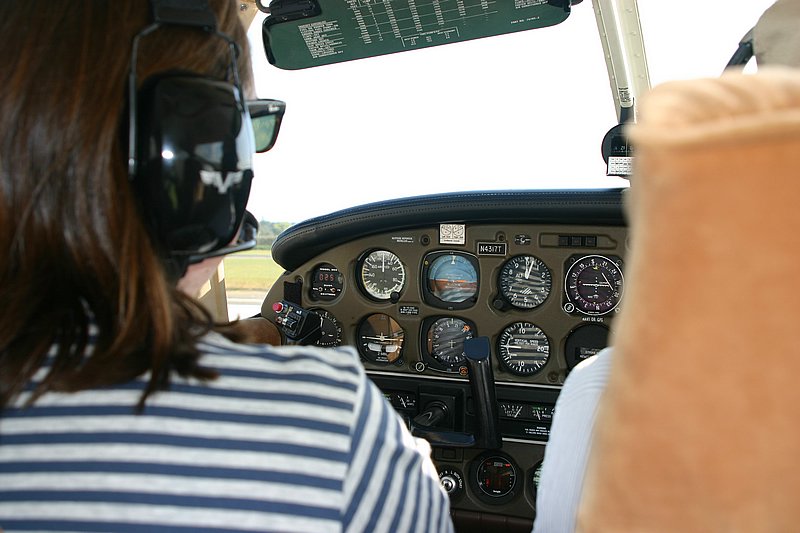
Here's a pic of the panel of the Arrow, and me with my foggles, on
approach to Block Island:

There's been other fun in the Instrument curriculum, like flying
"partial panel", without your two main instruments- in this picture
they've been covered up with sticky notes. You have to fly a
non-precision approach without your two main instruments as one of
the tasks of the checkride. This went pretty well.

And last week I had a new experience - flying solo through the New
York City airspace at night. An opportunity came up to fly
down to Wildwood, NJ (WWD),
with my instructor, so he could pick up an airplane and fly it
back. I'd end up flying back solo in a club plane. So we
went simulated-IFR down, with me under the hood, and asked to go via
JFK,
then direct to WWD. While we had skirted through NY's airspace
on my night cross-country (with their permission), flying down to
the Tappan Zee
Bridge,
we didn't really go far into the airspace. But this time it
would be right into the maw of the beast- some of the most busy
airspace in the world. But to go around it meant heading out
to sea, or going 100 miles around the area, or flying over it at
8500'.
It turned out to be no big deal - as we were getting up to altitude,
we requested transition through their airspace at 6500 feet (their
airspace goes up to 7,000). They worked on it and about 5
minutes later gave us the clearance to enter Class
Bravo Direct JFK, then on a 220
radial direct WWD. Cool!
The flight down was pretty uneventful, and took about 80
minutes. We used the autopilot most of the time, for
familiarity as well as accuracy. After dropping Dennis off I
turned around and headed back. With a 25 knot headwind it was
slow going, but flight following gave me someone to talk to, or at
least listen to, and helped me keep an eye on the planes landing at
Philadelphia
and McGuire
AFB. As I headed north it was getting dark, which was
something anticipated but not looked forward to - I hadn't landed at
night in 9 months. Good thing I never took the flashlights out
of my bag, and kept batteries in there. McGuire handed me off
to NY Approach
and they cleared me into the Bravo at 5500 and were vectoring me as
I got near JFK, to keep departures and me separated. Seeing
the 747's taking off below me and heading in my area certainly kept
me on the ball. Passing JFK the sun went down and I rigged for
night. There was a ceiling at about 5500 east of NY that
seemed to be getting lower, and as I headed toward Bridgeport I
could see the clouds getting closer, even in the dark. I asked
for descent and they gave me liberty to maneuver as I wanted since
there was no conflict and I was getting near the edge of their
airspace. I kept clear of the clouds and ducked below, and
then headed home. I'm pleased to report my night landing went
fine - stayed on the VASI the whole way down and touched down
nicely. Dennis had reminded me to keep my speed up and I
did.
An awesome flight with new experiences - solo night flight, the
Class Bravo, and a two hour leg, my longest so far. This is so great!
March
28,
2009
-
Leave
the
plane behind...
I've now been licensed a week and am starting to take up
friends. Wednesday I took Mike for a half-hour fly around the
area, just enough to get a feel for the experience.
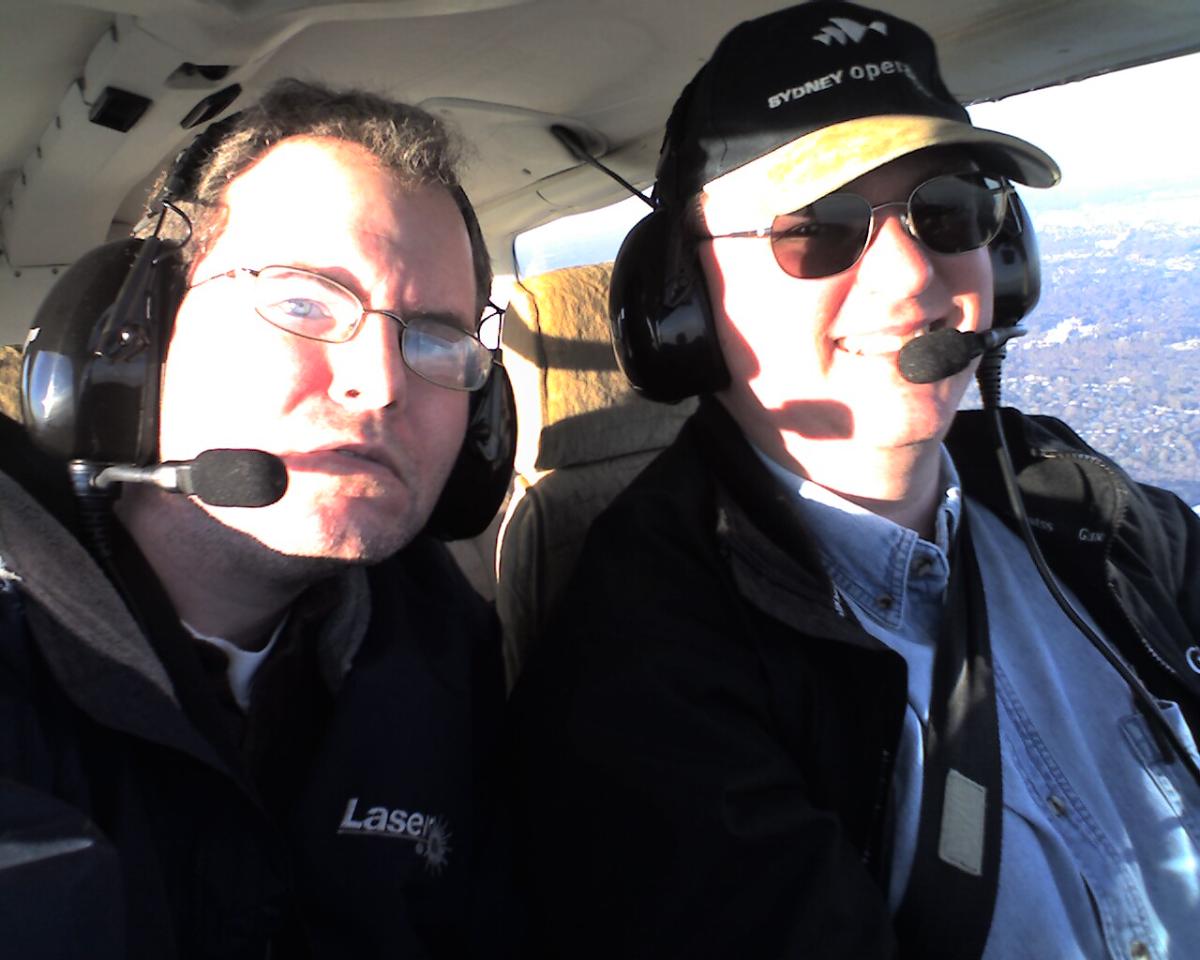
Today the plan was for us to fly to Hartford-Brainard and
pick up another friend then fly around the area for a while, maybe
down to the casinos.
A
storm
came
through
last
night, and the forecast was not great, but by early afternoon the
weather cleared and the storm appeared to be well south of us.
So we decided to go for a bit and see how it goes.
The flight up was nice, only 20 minutes, and Jen kept her
cool. We met Jon and then took off to the southeast. We
could see the clouds over Long Island,
but the CT shore was clear. It was about a half hour to Mohegan Sun at
a nice leisurely pace, and then made a nice easy turn past Foxwoods
and back toward Hartford. By now we could see the clouds
starting to roll in over the Sound and
begin
to
cover
the
shoreline
towns, including our original departure point. We had a nice
tailwind so there was no problem getting back to Hartford, but once
we landed a weather briefing was in order.
WSI showed no significant clouds or precipitation, but obviously
that wasn't quite true. I called the line crew at Bridgeport
and asked how the weather was down there, and they said they
couldn't see the runway due to the fog. Oh no! My
instructor happened to still be there and he said it was below IFR
minimums and no way I was getting back there, and it was going to be
like that for a couple of days.
So I arranged to leave the plane at Atlantic Aviation for
a few days ($15 a day, not bad) and we'd pick it up next week.
Oh well. It's better to be on the ground wishing you were
flying than the other way around!
March 21, 2009 -
Finally! A new Private Pilot
It's over, and I did it! I now hold a temporary Private Pilot
certificate. The checkride actually went much better than I
expected, and ended up being fun. I even learned some things, which
I hear is not unusual. Here's how it went:
Preflight
Got up early and got to the airport around 8, with the checkride
being at another airport at 10. Got the maintenance records
for the plane and went through them again, because something had
been gnawing at me. The plane I'm flying doesn't have its
original engine, it got a 180 hp upgrade years ago. But all
the performance charts seemed to have not been changed, and I was
assigned to do some takeoff performance calculations based on real
values. I wanted this to be right, so I went through the
actual manuals again and found there were no updated performance
charts. Hopefully that won't be a problem.
Got all the required paperwork in a folder for organization, then
went and did a very solid preflight. It was cold this morning
so I needed to give some extra time to warm the engine up.
Some people came in and knew it was the big day and all had very
encouraging words. I also called Flight Service for a weather,
NOTAM and TFR
briefing. All was well
Getting
to Danbury
I packed everything up, double checked everything was in place and
then started up a little before 9:30. Everything was normal,
and takeoff was at 9:30, and I headed on my route to Danbury. It's
only 20 miles, but the airport is behind some hills and I had not
been there before, so I was kind of nervous.
I used the VOR as a backup to my planned route, and got to the
vicinity and called Tower. As I got closer I could see the approach
end of runway 26 (roughly West) between two hills so as
I turned base I started to descend. But I had a 1000' of
altitude to lose and needed to descend steeply over the
highway. As I got to the runway I knew I was fast and not
going to bleed off enough airspeed to land safely, so I went
around. Tower wasn't too pleased, "I don't know, I'll figure
out what to do with you", and directed me around the airport to land
on runway 35 (roughly North), which was a little more into the light
wind, but was shorter, and you have to descend through a
valley. Great....
This time I watched my speed a lot more and had watched someone else
descend through the valley so I had an idea how to do it. I
landed right where I wanted to and slowed down in plenty of time
before the end of the runway. I taxied to the ramp, was parked
by an attendant, then shutdown, gathered my things and went into
Executive Air. It had already been a long morning....
I met the examiner, who thankfully was making coffee. We took
care of the details in the FAA IACRA
system, then got settled in for the oral exam. With
coffee. Black.
The
Oral Exam
He started by going through the maintenance records and asking
questions about the kinds of inspections that are needed for
different kinds of flying. Check.
Then he got out the Pilot's Operating Handbook (POH) for the plane
and paged through, asking many questions I expected and all of which
were worthwhile to know: Amount of fuel, oil, max takeoff weight,
the various critical airspeeds, whether the plane is spin approved,
the spin recovery procedure, and how the flap control works.
Check.
Then he went through the ASA
Private
Pilot Oral Exam review guide and asked about 50 questions out
of there. Good thing I read through that many times over the
last few weeks. Only a couple of minor memory lapses.
Check.
Next we discussed weight & balance and my proposed flight plan.
That was really brief. I had a few checkpoints but my first
major course change was at Bradley Airport. He said we'd start out
on the route and he'd probably divert me before then to some other
airport. He showed me an easy way of determining your
diversion heading using a pen and the VOR compass roses on the
chart, which made sense and which I hadn't seen before.
Nice. He then went over the plan and the order we'd most
likely do everything. Check. Then it was off to do my
preflight while he made a few calls. So far, so good!
The
Flight Test
We got settled in, and he noticed the GPS unit and asked if I knew
how to use it. It's not something I'm expert in, but I knew
the basics. Each of the planes I fly has a very different
system. He said not to worry, once you know one you can figure
them all out. He said he'd play with it while we flew, because
he was interested in getting one of that model for his own
plane.
Taxied to the runway, and set up for a short-field takeoff. I
talked through it while I did it and he seemed satisfied.
Started my clock and off we went to Laconia! I pointed out my
first checkpoint, the confluence of two rivers, and said I also had
a VOR as a backup if he wanted me to use that. He said to go ahead,
use what you have, so I set up to track that, then hit my second
visual checkpoint, a local highway. About 3 minutes later he
asked where we were, I pointed out some visual clues and showed them
on my chart, and then he said that was fine, then pointed to Sky Acres airport (44N)
on my chart and said he wanted to go there, and to give him an
estimate. I used his pen technique to point from my estimated
location to Sky Acres, then moved it to a VOR, keeping it parallel
to the angle it was at. Said I thought a heading of 310°
and about 25 NM. He played with the GPS and said it said
313° and 26 NM - good estimate. Now put that stuff away
and let's do some air work. I'm feeling good!
He said to do a steep turn, which is a 45° banked turn. I
did one to the left first, and did all right, since I was looking
outside like I had been practicing recently. In recent weeks
these had started to not be as good, but I did okay today.
Next to the right, and I lost a little more altitude than before but
he said it was fine. Now on to stalls...
The long-dreaded stall maneuvers, which had given me years of
apprehension, went okay. I first did clearing turns to look
for traffic in the area, and slowed down at the same time, then put
on full flaps and got set up in a 20° bank. My recovery
was okay and I was slowly gaining altitude, but it took me a little
bit before I remembered to take off the first notch of flaps.
Doh! At least I was doing everything else right and not losing
altitude.... Was that going to bust the checkride? He
then said to set up for a departure stall, I got to 60 knots, no
flaps, and set full power and nose up and a slight bank, but I kept
climbing and really had to work to raise the nose high to stall the
plane. Finally there was the buffeting, I identified the
buffet and recovered by lowering the nose. He was okay with
it. I guess perfection isn't a requirement. Whew!
Now instrument work.
I put on my foggles (plastic glasses that allow you to only look at
the instrument panel, not outside), and then did turns to two
different headings, a climb with a turn, then descend and track a
VOR radial. Next he put the plane into two "unusual
attitudes", in which he controls the plane to disorient you then
leaves the plane either climbing in a turn and slowing rapidly, or
descending in a turn and gaining speed. We did both, and I
thought my performance was fine. I guess he did too, because
he said to take the foggles off. Almost there!
He identified where we were, since I had not been looking outside it
wasn't obvious, but we were north of the Waterbury-Oxford airport
(OXC) and Danbury was behind us. He then took the
throttle control and closed it and said I just lost my engine and
not to spend much time trying to restart it, they never seemed to
restart on a checkride.... Time to do an emergency landing. I
was too far from Oxford to make it there, but we were in farm
country with lots of nice fields. Earlier we had been talking
about how long you can glide without your engine running, and he now
said we can use this opportunity to experiment and see how long we
can make it last. First I slowed down and trimmed for 73
knots, the best glide speed for my plane, which will keep us up the
longest. I picked out a nice long field that we could easily
make, since we were at least 4000' above the ground, and I looked
around for any other good options. I then started heading for
the field. There was another field around that had a worn
pattern which looked like it could have been a disused runway, but I
felt the other field was a better option. I started circling
over it, and he noted our altitude and said let's see how much
altitude we lose on a single circle. I kept the bank shallow,
and in one rotation we only lost about 1000', and it took what felt
like a long time, probably two minutes or more. Another two
circles and I thought I could make the field. He said he
didn't think so, do one more circle, so I did, and then I was more
at an altitude I could make. He said everyone makes that mistake at
first. A good learning experience, I never really thought we
could stay up for more than 5 minutes doing circles, but we
did. A good confidence booster.
Next he said let's find something to do a turn around a point over,
and he said let's use a pond which was located at a schoolground,
which was closed since it was Saturday. Winds were light so I
needed a little wind correction, but not a lot. As I was
coming around to finish one turn he said okay, let's head back to
Danbury for landings. It's almost over!
I headed toward the airport and he showed me the area since I wasn't
too familiar. Tower said to report over the prison, and the
examiner said that was fine, which I told tower. He asked me
how I would know where the prison is if I wasn't familiar? I
said, ask? He laughed and guided me to it and pointed out how
to align myself with it and the bank of Candlewood Lake which would
be on a perfect approach to the airport. Good knowledge for future
flights. I went through the before-landing checklist as had
been drilled into me over and over and over...
We needed to do three landings, and I thought to do soft-field
first, which I had least experience with. The goal is to come
in and land as softly as possible and hold the nose off, because if
you landed on soft grass or mud, it might grab the nosewheel and you
could nose over. I came in a little harder than I liked, but
he said I had the general idea.
Next time around I tried a short field landing, I got a little slow
and cut power a little early so we landed a little hard but it was
definitely short. We taxied back for a soft field takeoff and
that was okay.
We got into the pattern and during the circuit talked about some
ways to improve those landings, which he said were all right but I
should continue to practice them. On landing he said to taxi
to Executive Air. He hadn't said anything had gone wrong, so I
must have passed. YES!!!
Total
flight
test
time,
1.7
hours.
After filling out the paperwork and a little debrief we were done,
and I had temporary certificate in hand. It felt incredible,
and an amazing relief. I made a few calls and then took off
for the 20 minute flight home. In the pattern, Tower asked if
I could make a short approach. Of course I can, I'm a pilot!
March
20, 2009 - The anticipation is killing
me
It's been a while since I've posted here, but it's not for lack of
activity. Since my last posting, I completed my long
cross-country, my night requirements including a cross-country
flight, and hours and hours of practice. Finally, tomorrow,
TOMORROW, is my checkride! I have it scheduled with an
examiner at the airport in Danbury, CT, which so far, I have never
flown to. I'll do it for the first time tomorrow morning. So
much to remember, so many things to get organized. The
anticipation is killing me...
On November 3 I had completed 58.1 hours of flight time and 297
landings. Today, the number stands at 81.8 hours and 368
landings.
At the end of November I did the long cross country flight, which
had to be at least 150 NM long with three stops. I flew first to Columbia County, NY (1B1),
then to Barnes Muncipal in
Massachusetts (BAF), which has a nice 9000' runway, then
returning to Bridgeport. This was delayed a few times due to
weather, and the day I did this there was weather forecasted to move
in later in the afternoon, so I got an early start. Everything
was going well but on the last leg I could see the clouds rolling
in, and I had to duck under them to stay VFR, so I lost NY
Approach's flight following because they couldn't see me any
more. It was okay, I could see my destination.
After that, since it got dark earlier, we got started on the 3 hours
of required night flying, which included landings and a
cross-country. My instructor usually takes people to Greenwood Lake Airport in New
Jersey (4N1), because it's a nice flight past New York City,
and the airport is in a really dark area, so you have to work for
it. Night flying is nice, but you do have to be aware of your
instruments and anything
which makes you think you're getting into a cloud. On our
return from Greenwood Lake we were at an altitude where we could see
snow starting to fly past the wingtip lights, which was a neat
effect, but definitely had us paying attention.
With the cross-countries and night work done, and the holidays over
with, it was time to just practice, practice, practice the maneuvers
required on the checkride. The stalls used to be a worry
but those turned out to be not a real problem, even stalls in a
20° bank. Steep turns, which had been done well almost all
the way through my training started to slip, but have gotten good
enough to pass. The consistent source of trouble was ground
reference maneuvers, in particular turns around a point.
In turns around a point you maintain a constant radius from a point
on the ground while adjusting for wind, which affects your
groundspeed, and the crab angle you maintain around the point.
For whatever reason, despite understanding it, picturing it, and
going around a point until it made me dizzy, it still was tough to
do consistently. I think by today it's good enough, I've been
practicing still, but we'll find out tomorrow.
S-turns across a road is another maneuver that was somewhat
difficult to do consistently, though I think it's partly due to the
lack of straight roads in this part of the country to do the
maneuver over. I don't think these were ever very poor, but
were never my specialty. The examiner only needs to test you
on one of the 3 ground reference maneuvers, but can test you on all
of them. Hopefully he's kind.
This week I've flown several times, re-read the red Gleim books,
re-watched a King checkride video, re-read the ASA Private Pilot
Oral Exam Guide, gone over the airplane maintenance records a bunch,
planned my cross-country to Laconia, NH and have basically agonized
over being as prepared as I can be. At this point I'm as ready
as I will ever be. Wish me luck!
November 3, 2008 - The
Cross-Country Flights
Hello vicarious travelers! It's been a busy few months and I'm
happy to report solid progress on the pilot's license.
As you may have seen, I was away
for about a month, and since I've been back it's been mostly
work and flying.
Since I got back, I took a week of vacation and did a lot of
flying, and that has really helped. My landings have gotten very
reliable, and my handling on crosswind landings have gotten quite
good too. I've had 19 flights since I returned, totalling 22.8
hours, and now I'm doing the last major activities of the training
- solo cross-country flight.
I had some "dual" cross-countries with a couple of instructors,
and went to Westerly RI, Windham CT, Worcester MA, Bradley
International north of Hartford, down to Montauk, Fisher's Island,
and some other places. This was good training in the main
navigation methods - pilotage, dead-reckoning
and radio-aid navigation.
"Cross-Country" in this sense is not flying coast-to-coast: it's
flying to a different destination from where you started.
For the pilot's license, there are certain requirements, such as
being more than 50 nautical miles away from your original
location.
On Friday, 10/24 I took the day off, and took my written exam in
the morning. Got a 93, thanks. In the afternoon, I did my first
solo cross-country, which was to Westerly, Rhode Island
(KWST), a nice small airport just past Groton, CT, and easy
to find, because you can just follow the shoreline. I used VOR
navigation as well, for the practice.
This is looking northeast, in the Madison area.
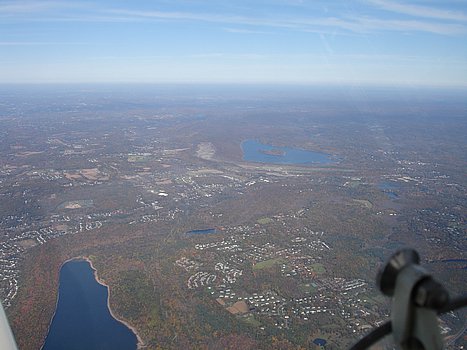
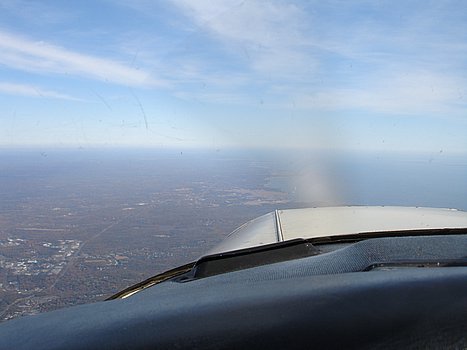
Here I'm looking over the cowling toward my destination - Long
Island Sound is on the right.
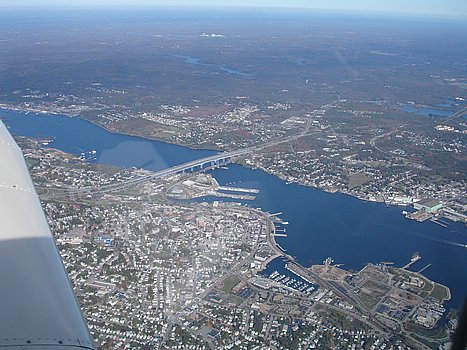
Here's the big bridge in New London.
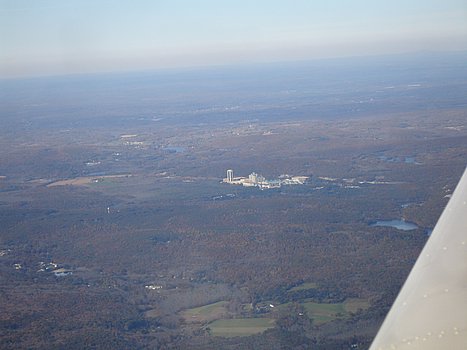
The Foxwoods casino is easily visible from a mile up.
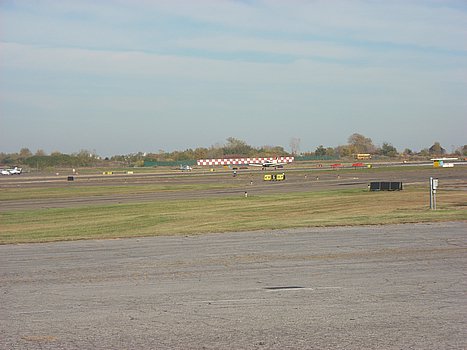
After landing, contacting Flight Services to close my flight
plan, calling my instructor to tell him I made it, and filling out
my log book, I went inside and had some very nice people sign my
logbook to prove I was there. I then flew back along the same
route. I called Dad beforehand to tell him I was leaving, and he
was at the airport to greet me when I arrived. He took the picture
at the top of this posting after I shut down, and this of my
touchdown. A very successful day!
Next, on Friday, 10/31 I took the afternoon off, and flew to Orange County, NY
airport (KMGJ), which was challenging because it was the
first time I flew somewhere I had never been before, and where I
did not know the area.
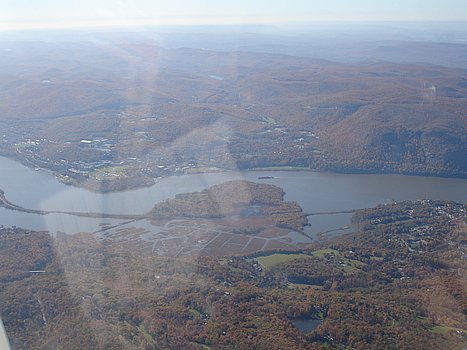
Here I'm just reaching the Hudson River. It's definitely autumn.
West Point should be over in this area.
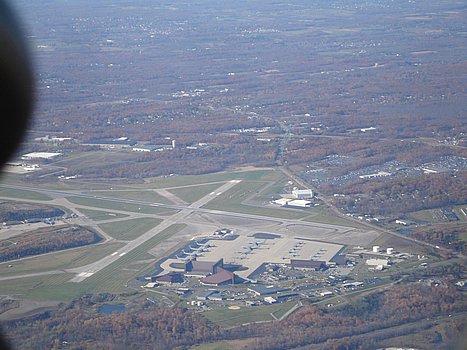
Here's Stewart International Airport. I didn't have to talk with
them because I was flying over their airspace.
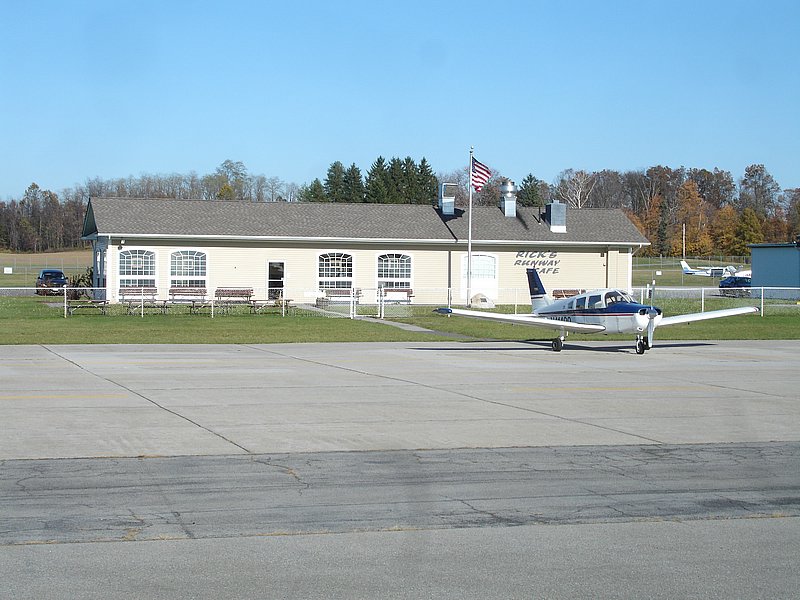
After a good landing I taxied to my destination: Rick's Runway
Cafe, a nice restaurant right on the field. I had time for lunch,
which was a really good meatball sub and fries. And someone signed
my logbook here too.
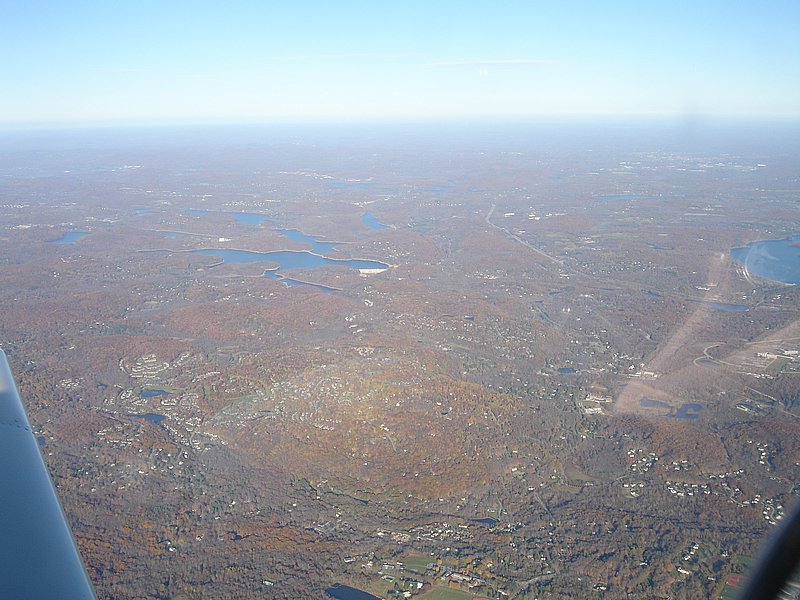
And here's my final picture from the trip - some of the lakes
just west of the CT border. It's definitely autumn.
The trip home was uneventful, and fast - there was a big tailwind
so I was doing about 150mph over the ground. Cool!
Soon I'll do my long cross-country, do the 3 hours of required
night flying, and practice the required maneuvers for the
checkride. Hopefully in a month or so I'll have my license. A long
time coming.
July 17, 2008 - First Solo!
I'm happy to be able to write that yesterday, 7/16 I had my first
solo in Piper Warrior N80964. It took a while, and I'm still not
completely confident, but I proved I can takeoff, land, and bring
myself and the plane home in one piece, in light to moderate
crosswind.
Total time: 35.3 hours (23 in 2008, 10.3 from 2005)
Total Landings: 181 (151 in 2008, 30 from 2005)
Crosswind correction continues to be an issue, and the last few
inches of the flare, although they were good enough during my solo
for the tower to tell me I did a good job. Stalls are generally
okay, I'm able to keep my altitude loss mostly at minimum, and we
just did turning stalls for the first time earlier this week.
Steep turns have been good right until the last week, for some
reason I started losing altitude when I hadn't before. Ground
reference maneuvers seem to be my toughest challenge - turns
around a point were better last time but I still have a tendency
to get closer to the point. Think I need to look at the ground
more and less at the point, but maybe not. We've only done S-turns
a couple of times, and no one yet has taught the rectangular
course except in the actual traffic pattern, which is far from
rectangular due to noise abatement necessities. It doesn't help
that there are few rectangular ground objects or straight roads
here in Connecticut.
So I'm pleased that I've made a lot of progress, and am excited
to continue improving and proceeding with more cross-countries.
Lots of people will solo in less time than I did, but I'm happy
with where I am. I won't be flying for the next month while I'm on
a trip to Japan, but I'll be back with more stories in September.
Hopefully I can finish the Private Pilot by the end of the year.
June 17, 2008 - Making
Progress
I wrote a while back that I've started flying again. This time it
looks good: I'm close to an airport, I've got some spare time, I
have the money, I have no major trips planned until later this
summer that would impede progress, and most importantly, I have the
motivation. That and a good instructor.
So in the last 6 weeks I've had 7 lessons, have flown a 1983
Piper Warrior for 6.4 hours of Hobbs time, taken family and
friends up in a Cherokee Six once, and landed 57 times. Dad came
up for the ride and has enjoyed it, even taking pictures along the
way.
I'm doing okay I think, and Dennis is readying me for solo. Still
have to get landings down better, I'm improving but not quite
there yet. Steep turns are good, stalls are decent, need some more
time on ground reference maneuvers, and rote memorization of
things like emergency procedures are hard for me to recall. But
I'll get there.
I'm on vacation for two weeks and am flying 7 times (weather
permitting) so I'm hoping to solo during this time. Wish me luck!
May 14, 2008 - First 3
Lessons
After a 3-year hiatus, I've finally think the planets have aligned
properly so I can start flying again.
While I enjoyed my lessons in 2005, I think the combination of
the tiny Tomahawk plane, my general jitters about stalls and
spins, coupled with all the pressure of planning and anticipating
my imminent India trip, made it hard to get far. I also found that
if I didn't have a block of time to dedicate to multiple lessons
that it was more an expensive roller-coaster ride, and less a
progression in skill.
So right now, I have a few months without large trips planned, so
I have started flying again, and I'm really enjoying it and am
excited!
I've had 3 lessons so far - the first was more a re-introduction
and getting used to a new school, which is organized as a flying
club, a new instructor who is highly qualified and makes me feel
relaxed, and a larger plane, the Warrior series.
We went for a flight in the area, did some stalls, steep turns,
and I found I could actually handle it and remember things. My
landings were not great but we lived through them.
My second flight two weeks later, built on the foundation but was
really fun. We took a cross-country flight from BDR to Groton,
over the sound and back to BDR, and took some family and friends
in a 300 hp Cherokee Six with variable pitch propeller. This is
not normally the training aircraft of choice; in fact I can't rent
it without a PPL and special endorsements, but we needed a plane
large enough for the 5 of us, plus it was way fun to fly. Read the story.
My third lesson, the following day, was in a 160 hp Warrior II,
which is what I'll typically be flying. This was going to be a
local flight, but turned into a trip to Waterbury-Oxford airport.
Did some navigating, but not a lot of maneuvers because it was
pretty bumpy. But I did ok and had 6 landings.
I'll post more here as it goes on. Hope you enjoy following along.
Flying Lessons - Resumed!
April 25, 2008 - Getting
Started
I've long wanted to learn to fly. I didn't realize until recently
how long-term and pervasive that desire was, because I didn't really
act on it for long. I took some flying lessons in 2005 and as of May
have started them up again with the hope and expectation of
completing my Private Pilot. I should have lots of interesting
things to post here. Here's some links to some earlier pages about
flying:
Flight
Training (The Introductory flight)
Dad
takes the controls - December 1, 2005
A flight I took
in May with my instructor and some family.
